
If you run a brand in Australia and you are shopping for custom boxes, you have probably noticed a familiar split. Local print-on-demand companies promise a fast turnaround and a small minimum, while overseas factories quote a much lower unit price but come with a question mark over freight and timing. Neither option is universally right. This guide walks through what actually matters for Australian brands: the reality of sea freight from Guangzhou, how box dimensions drive your landed cost, and how a factory-direct MOQ of 500 pieces lets you test a design without committing to a warehouse full of stock.
Why Australian brands look beyond local suppliers
There is a straightforward reason so many AU brands end up talking to factories in Guangzhou. Australia has a relatively small domestic print market, and short-run custom board is expensive locally. A local print shop or online configurator is brilliant when you need fifty boxes next week or you are still deciding on a brand identity. It is less compelling once you are shipping a few hundred units a month and paying a per-box premium that never goes away.
A factory in Guangzhou makes its money on volume and runs its own presses, so the same rigid gift box or corrugated mailer can cost materially less per unit on a 500-piece run. The trade-off is distance, and that is mostly a freight-planning problem rather than a mystery. We will be honest below about where a local supplier genuinely wins.
Sea freight and lead time: the honest timeline
For most Australian orders, sea freight is the default. It is by far the cheapest way to move several hundred boxes, and the transit time is predictable once you have shipped before. The number buyers tend to miss is that production and transit are two separate clocks. At Ecopaperbox, production runs 7-12 working days after artwork approval. Sea transit from South China to an Australian port is typically measured in weeks rather than days, and customs clearance sits on top of that.
Plan backwards from the date you need boxes in your hands, not the date you want to place the order. If you are launching into a Q4 retail window or a big online sale, add a comfortable buffer: a peak-season delay is far easier to absorb on paper than in a warehouse. Air or express freight can compress transit when you genuinely need it, but it changes the economics of a low-MOQ order.
Right-sizing and flat-ship structures cut the biggest cost
Freight is charged on volume as well as weight, which is why oversized boxes quietly cost more than the product inside them. Right-sizing, matching the dieline to the product with just enough room for protection, is the single biggest lever you control. A free dieline from the factory lets you spec exact dimensions before anything is printed.
Structure matters just as much. Folding cartons made from SBS white card or kraft, and corrugated mailers in E, B or F flute, all ship flat and fold at your end. Rigid gift boxes, built from greyboard of 1000-1500 gsm mounted with 157 gsm C2S art paper or specialty paper, ship assembled and take up far more space. The one exception is the collapsible magnetic box: the same greyboard-and-paper construction, built with hidden magnets so it folds flat. If you want a premium rigid feel without paying to ship air, that is the structure to ask about. Our guide to rigid vs folding boxes goes deeper on the trade-offs.
MOQ 500: enough to test, small enough to be safe
Ecopaperbox standard MOQ is 500 pieces across every box type, rigid, folding, kraft and corrugated alike. The industry norm at many factories is 1000 to 3000 pieces, so 500 still reads as a low-MOQ, test-market-friendly run. It is a deliberate number: enough boxes to dress a real retail shelf or run a genuine ecommerce launch, without tying up cash in inventory you may need to redesign.
That matters for Australian brands in particular, because every extra carton has to cross the equator. A 500-piece run lets you validate the unboxing, photograph the real product and measure sell-through before you scale. When the design works, reordering from the saved dieline keeps colour and structure consistent. A common mistake is treating the first run as a cheap one-off rather than a real test; send it to actual customers and collect feedback before you commit to thousands.
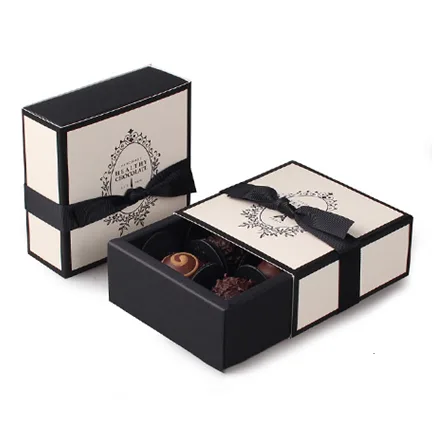
Local print-on-demand versus a Guangzhou factory
Be honest about the alternatives. Services such as Arka, Noissue and Packlane, and local Australian print-on-demand shops, are genuinely good when you need a very small run quickly, want an easy online configurator, or are still experimenting. Their costs are transparent and the logistics are simple. Their limits show up at scale: per-unit pricing stays high and the range of rigid structures is narrower.
A Guangzhou factory is a different tool. Ecopaperbox is a real manufacturer with in-house offset printing, lamination, die-cutting and hand assembly under one roof, not a sourcing agent reselling someone else's boxes. That in-house control is what keeps colour consistent, turnaround short and overhead low. Clients are welcome to visit the Guangzhou factory; many international buyers tour the production lines and review samples on site before ordering. For quality assurance we hold ISO 9001 for our workshop, High-Tech Enterprise certification (GR202544012474, valid from 19 December 2025 for three years), and an SGS-audited facility. FSC-certified paper can be sourced from FSC-certified mills, with chain-of-custody documentation available on request; we describe that carefully rather than claim a certificate we do not hold.
For landed-cost clarity, ask for a DDP quote so freight and duty are included; our note on DDP vs EXW explains why. If your item is lightweight and you value a premium rigid finish, a factory-direct 500-piece run can land in Australia for less than you might expect.
The bottom line: choose local print-on-demand for speed and tiny runs; choose a Guangzhou factory when you want structural range, factory-direct pricing and a controlled 500-piece test. Either way, right-size the box and treat the freight clock as separate from production.